UK Golf Betting — 2026 Edition
Golf Betting in the UK: A Complete Guide for 2026
Smart wagers, sharper stats — UK golf betting decoded.
By Golf Betting Analyst
 Available in US

Place a £10 each-way on Rory McIlroy at the Open and you are not just backing a result — you are renting space inside a regulatory and pricing machine the casual punter never sees. Golf betting in the UK sits across four working categories in 2026: outright winner, top-finish markets, head-to-head matchups and a long tail of specialty plays. All of them are priced inside a fractional-odds tradition, all of them governed by the UK Gambling Commission, all of them about to feel a tax bill the government keeps promising will not touch the punter.
Nine seasons of building strokes-gained models and watching UK books re-price their majors boards has taught me one thing above all: golf bettors are dealing with a different animal. Football is ninety minutes, two outcomes plus the draw, and a market thick enough to absorb your stake without flinching. Horse racing is a few minutes, twenty-odd runners and a price that moves on rumour. Golf is four days, 156 runners more often than not, a leaderboard that turns over every five minutes, and a winner who lands at 25/1, 50/1 or — if you really squint — 100/1.
That single fact rewires the maths. The each-way structure horseracing treats as an afterthought is the load-bearing wall of the UK golf shop. Variance, course fit and weather move prices in ways football modellers do not need to think about. And the operator’s margin now sits inside a tax regime that, from April 2026, looks nothing like the one we have lived under for the past decade. The rest of this guide is the working map I would hand any UK punter who wants to bet golf in 2026 without leaving free money on the table.
Table of Contents
- What you need to know before placing your first golf bet
- Why golf is a category of its own on a UK betslip
- The four axes a UK punter actually bets on
- Each-way is the bet that makes golf bettable
- The five weeks that anchor the calendar
- Strokes Gained changed how I read a card
- What the tax and affordability shake-up means for your golf betslip
- Live betting on a sport that moves at five-minute intervals
- The same tournament looks different to a beginner, an intermediate and a sharp
- What I run through before clicking confirm
- How to judge a UK book on its golf shop, not its football
- The integrity machinery you do not see
- Holding your nerve and your bankroll
- A UK punter’s year on the golf calendar
- Ten words you will keep meeting
- Questions UK punters keep asking me about golf betting
- Five threads from this guide worth pulling
What you need to know before placing your first golf bet
- UK golf betting runs on four market families: outright, top-finish positions, head-to-head matchups and specialty plays — each with its own pricing logic.
- Each-way is what makes longshot golf bets survivable — stake doubles, half on win, half on a finishing place, fraction usually 1/4 or 1/5.
- Remote Gaming Duty rises to 40 percent in April 2026 and a new 25 percent Remote Betting Rate follows in 2027 — golf is in, horseracing is out.
- Affordability checks now bite at £150 of net deposits across thirty days — that threshold quietly shapes how a UK punter paces a season.
Why golf is a category of its own on a UK betslip
The honest reason I started taking golf seriously as a betting category was a Wednesday morning at Royal Liverpool. I had walked the front nine in horizontal rain, watched a marquee group lose a ball on the eighth, and realised that nothing about what I had just seen was being priced into the boards I had checked at breakfast. That gap — between what is observable on the course and what is fixed on the betslip — is the entire reason golf is its own job inside the UK industry.

The numbers around the wider gambling industry frame the conversation. The UK gambling sector’s gross gambling yield reached an all-time high of £15.6 billion in 2025 — “at its highest ever level,” in the words of UK Gambling Commission chief executive Andrew Rhodes at that February’s Betting and Gaming Council AGM. Online real-event betting GGY in the first quarter of 2025 was £596 million, up 5 percent year on year, with 13.5 million monthly active online accounts behind it. Grand View Research has UK sports betting on a trajectory to roughly $21.3 billion in revenue by 2030 at an 11.4 percent compound annual growth rate.
Golf’s market share inside that GGY pie is smaller than football or horseracing, but it punches above its weight on three metrics: average customer dwell time, share of each-way stakes and the proportion of accounts that bet a single market across multiple weeks of the same tour.
Why is that? Because, unlike football’s domestic-league cadence, the PGA Tour and DP World Tour together produce more than fifty tournaments a year. There is almost no week of the calendar without a serious betting card. That continuous supply is what lets UK books carry deep golf live-betting menus and what gives the bettor an edge a football market cannot offer — the chance to track a specific golfer’s form across half a dozen consecutive events and price the gap between perception and performance yourself.
The four axes a UK punter actually bets on
Open a UK book’s golf page during Open Championship week and you will count, depending on the operator, somewhere between thirty and seventy listed markets. That sounds chaotic. It is not. They all funnel down to four working categories, and once you carry that mental map onto the betslip your decision time per bet drops by roughly the time it takes to pour a cup of tea.
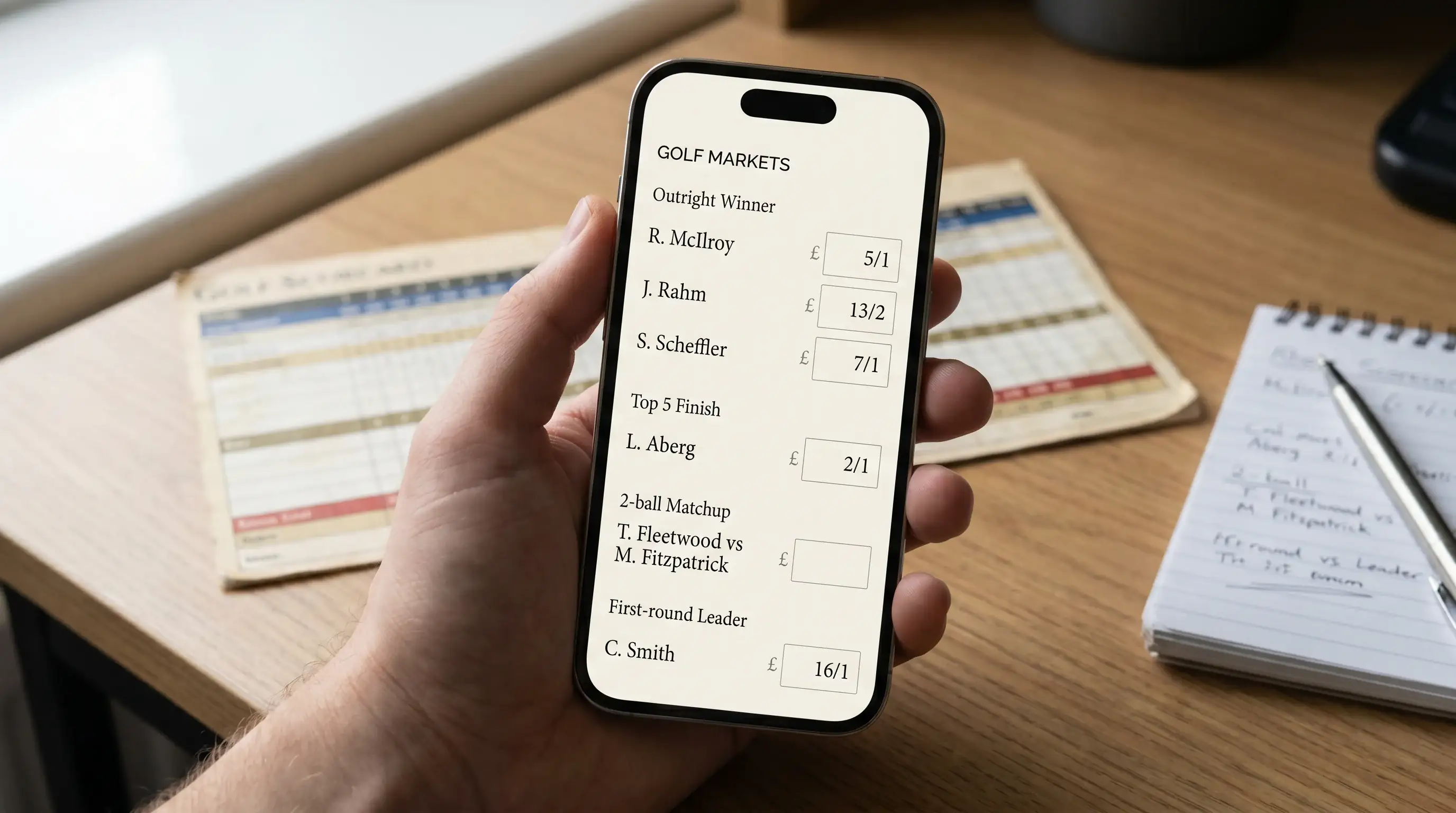
Outright winner
A bet on who lifts the trophy. The benchmark market — every other card grew out of it. Standard PGA Tour event favourites sit at 5/1 to 10/1, mid-tier runners at 25/1 to 50/1, longshots at 100/1 or longer. Each-way available on almost every priced runner, with 5 to 10 paid places depending on the event and operator.
Top-finish markets
Top-5, top-10, top-20, plus top-half. Pays on finishing position, with no win leg. Prices roughly mirror what an each-way outright would pay on the place portion alone. The honest substitute for an each-way bet when you do not believe in the winner but believe in the leaderboard.
Head-to-head matchups
Two-ball and three-ball duels — one round, one metric (score), one winner. Tournament matchups extend the principle across all 72 holes. Markets thin in the deeper field but thick at the top, especially among grouped marquee players.
Specialty and bet-builder
First-round leader, make-the-cut, group winner, winning margin, hole-in-one, nationality of the winner, leading European, bet-builder combinations. Variance is high, liquidity is patchy, but the edges that survive on a UK book usually live inside this drawer.
The reason this taxonomy matters more than it looks is liquidity. Outrights and head-to-heads are the deep pools — the prices stay tight, the betting limits are friendly, and the operator’s margin is competitive because they trade in size. First-round leader, specialty markets and bet-builders are shallower water, which means wider margins but, occasionally, value the model upstairs missed. As a working rule I treat the top half of the table — outrights, top-finish and matchups — as the bread and butter, and the bottom half as the room where I let myself be opportunistic.
For a per-market breakdown of how each of these is priced, when the line moves and how to spot the soft inputs, our guide to UK golf betting markets and bet types walks through every individual market with worked examples.
Each-way is the bet that makes golf bettable
The first time I placed an each-way bet I did the maths wrong, lost a stake on a winner I had backed, and have been suspicious of “automatic” betslip behaviour ever since. The error was small but instructive: I had read 1/4 as “you get a quarter of your stake back if they place” rather than “your place return is calculated at a quarter of the winning price.” It is an easy slip, and it is the single most expensive misunderstanding in UK golf betting.

The structure itself is straightforward once you have the vocabulary. An each-way bet is two stakes welded together. Half goes on the win, half goes on the place. In golf, the bookmaker pays the place portion across a defined number of finishing positions — typically five to ten depending on the event — and the place price is the win price multiplied by a fraction, usually 1/4 or 1/5.
Each-way fraction — the multiplier applied to the win price when calculating the place return. A 1/5 fraction on a 25/1 outright pays 5/1 for a place; a 1/4 fraction on the same price pays 6.25/1. Generous on paper, but each book sets the fraction differently across event tiers.
Worked example — £10 each-way on a 20/1 outright with 1/5 fraction over 7 paid places.
Total stake: £10 win + £10 place = £20 outlay.
If the golfer wins: win return £200 + £10 stake back, plus place return £40 + £10 stake back. Total: £260.
If the golfer places in the paid 2nd through 7th: place return £40 + £10 stake back; win portion lost. Total: £50.
If the golfer misses the cut or finishes outside paid places: £20 lost.
This is the structure that lets UK punters back longshots without their accounts looking like a tip jar. The global golf betting market was valued at roughly $3.5 billion in the United States alone in 2023, and a meaningful share of that flow sits in each-way and top-finish products precisely because the structure is forgiving on a sport where the winner you nominated last Sunday could finish 14th, 50th or missed the cut.
One nuance I will not bury: when more than one golfer finishes tied for a paid place, the stake on the place portion is reduced. That is the dead-heat rule, and the formulas behind it deserve their own treatment. For the full mechanics of each-way, including fractions, dead-heat reductions and extra-places promotions, our dedicated guide to each-way golf betting is the place to spend a careful half hour.
The five weeks that anchor the calendar
Five weeks of the year do the work of fifty. That is the line I open most pre-season briefings with, and it is barely an exaggeration: the four men’s majors plus the Ryder Cup or Solheim Cup pull roughly two-fifths of a UK book’s annual golf turnover into a calendar window that is barely two months wide. If you only bet golf five weeks a year, those are the weeks.

Each of the four majors has a fingerprint. Augusta is a closed shop — somewhere around ninety players, mostly the same names year on year, and the field is shaped by previous winners’ lifetime exemptions. The US PGA Championship rotates its venue with no characteristic course archetype, which makes it the hardest major to model from history. The US Open is the USGA’s annual lesson in penal rough and small greens. The Open Championship runs 156 players, with about 65 percent of the field set by 28 exemption categories and another 46 places filled through the Open Qualifying Series — that depth means it serves up the longest each-way places of any week on the calendar.
The Masters
Roughly 89-player invitational field. Augusta lifetime exemptions make this the most data-stable major — same names year on year, course-fit dominant over current form.
US PGA Championship
156-player field on a rotating venue. The most fluid major in terms of historical correlation; course-fit carries less weight than at the other three.
US Open
USGA’s penal setup rewards course management over raw distance. Over/under bogey markets carry historical edges. Cuts often fall around level par.
The Open Championship
156 starters, around 65 percent of the field by exemption, 46 places via the Qualifying Series. Scottie Scheffler opened at 5/1 in 2025 — the shortest pre-tournament Open price in a decade, matching Jordan Spieth’s mark from 2015.
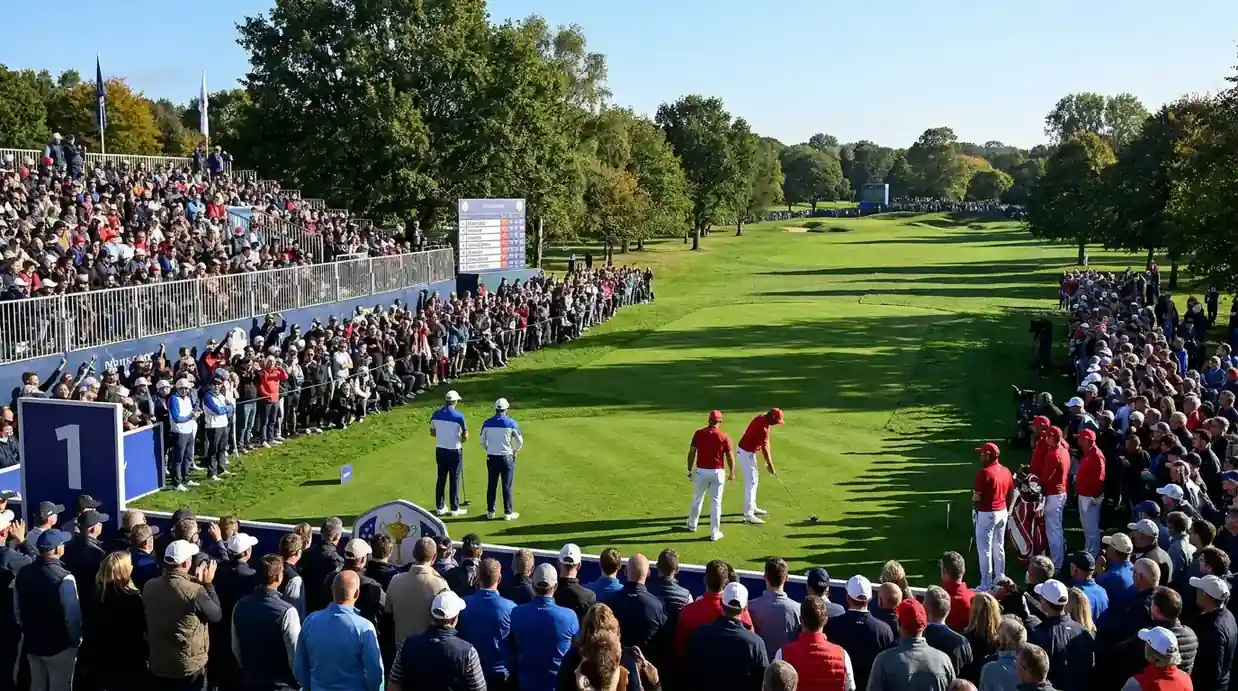
Then there is the Ryder Cup, which is its own animal. At the 2025 staging BetMGM reported about 70 percent of action coming in on the United States to win, with 58 percent of tickets and 68 percent of stake landing on Team USA; ESPN BET saw the tie market — priced around 12/1 — take just 4.6 percent of bets. The cup format means team plays (foursomes, fourballs and singles) sit alongside outrights, top points-scorer and individual matchups in a way no stroke-play week replicates. Pricing logic is upside-down: home advantage is genuine — only three away teams have won since 1995 — and team-versus-team variance is much lower than 156-player variance.
For deep dives on every major’s data quirks, each-way norms and pre-tournament workflow, our cluster on golf major championship betting takes them one by one.
Strokes Gained changed how I read a card
One late-season Sunday years ago my model had a name I had barely heard of priced about 12 percent of fair value cheaper than the UK board on Sunday morning. I held my breath, took the each-way, watched him birdie three of the last five and pay out at 33/1 with a 1/5 fraction over eight places. That is the moment I stopped looking at golf form columns the way the newspapers print them.

The reason is Strokes Gained, a metric built by Columbia University professor Mark Broadie around 2011 on the back of the PGA Tour’s ShotLink data infrastructure. Instead of asking “did the golfer make a birdie?” it asks “did the golfer pick up or lose strokes compared to the field’s expected outcome from that exact lie?” The category splits into four working channels — Off-the-tee, Approach, Around-the-Green and Putting — and each one rewards a different kind of golfer on a different kind of course.
For the UK punter the punchline is this: world ranking points and money-list positions average across everything, while Strokes Gained tells you what kind of golfer somebody is. A player ranked 40th in the world who is sixth on tour in SG: Approach is not the same proposition as a player ranked 40th who is sixth in SG: Putting — and the second has been shown to be statistically much closer to luck than the first.
“The most challenging aspect to predicting golf is actually finding things that are meaningfully predictive. If you have a baseline model for projecting golfer performance that just uses a time-weighted average of their past relative scores — adjusted for field strength — this will be surprisingly hard to improve upon.” That admission, from the founders of Data Golf, is the honest starting point for anyone trying to add quantitative edge to a golf betslip.
The candour of that quote is exactly the right place to begin. Strokes Gained is not a magic decoder ring. A 2024 systematic review of machine learning in sports betting referenced research on 19 major championships between 2018 and 2022 showing that OWGR is the leading correlate of “to win” prices for top-ranked players, while SG metrics increasingly dominate for lower-ranked entries — meaning the data edge is concentrated exactly where the casual punter is most likely to ignore it.
For a working introduction to Strokes Gained as a betting tool, including which sub-category drives which kind of bet, head over to our cluster on Strokes Gained and data-driven golf betting.
What the tax and affordability shake-up means for your golf betslip
Two dates inside my own calendar are the ones I keep coming back to: 1 April 2026 and 1 April 2027. Most UK punters have not heard of either. They will feel the second more than the first, but the first is what actually arrives in the post.

From 1 April 2026, Remote Gaming Duty rises from 21 percent to 40 percent on online casino. From 1 April 2027, a new Remote Betting Rate of 25 percent kicks in on online sports betting — and crucially, while UK horseracing, spread-betting and pool-bets are excluded, golf is not. The Treasury’s Autumn Budget 2025 projects these changes will raise £810 million in FY2026/27 and grow to £1.16 billion by FY2030/31. That is real money pulled out of the operators’ margin, and it has to come from somewhere.
UK gambling-sector market cap lost more than £8 billion across the trading day after the Autumn Budget was published. Evoke, the William Hill UK parent, dropped 18 percent on the news.
That market reaction is what makes this section more than backline regulatory trivia. When duty rates rise faster than the rate of new customer growth, the operator can do one of three things: absorb the cost, raise margins, or trim promotions. UK books have already started visibly trimming the third — fewer “extra places” promotions, tighter best-odds-guaranteed on outsiders, less liberal each-way fractions on second-tier events. None of that change is loud. It is the kind of compression you only notice when you have spent ten months staking a golf book and look at the average return on £100 of each-way stakes versus the same set of bets two seasons ago.
“Year on year we saw a 300 per cent increase in the number of criminal cases we were taking as a regulator.” Andrew Rhodes’s IAGR Conference address in October 2025 is the data point that explains why regulators are pressing harder on the licensed market while duty rates push more cost into it — the cost-pressure squeezes the operators, the criminality watch keeps the punter inside the regulated perimeter.
Sitting underneath the tax changes is a separate but equally consequential shift. Since February 2025 the threshold for a light-touch affordability check has been £150 of net deposits across a thirty-day window. Deposit more than that, and a UK-licensed operator can ask for source-of-funds evidence — bank statements, payslips, P60s. The point is not whether £150 is the right number. It is that the bettor who once thought of £20 a week as a casual habit is now, twelve weeks into the year, the same statistical category as a customer the operator has a legal duty to scrutinise. Plan your staking accordingly.
For a working walkthrough of how the duty changes flow into your golf betslip, how affordability checks are implemented in practice, and what the integrity regulator can and cannot do about it, head to our cluster on UK golf betting regulation and responsible play.
Live betting on a sport that moves at five-minute intervals
You can be quicker than the in-play board in golf. That is not true in football, where prices move in milliseconds. It is not really true in tennis either. It is true in golf because the data feed is, in regulatory terms, on a roughly five-minute leash.
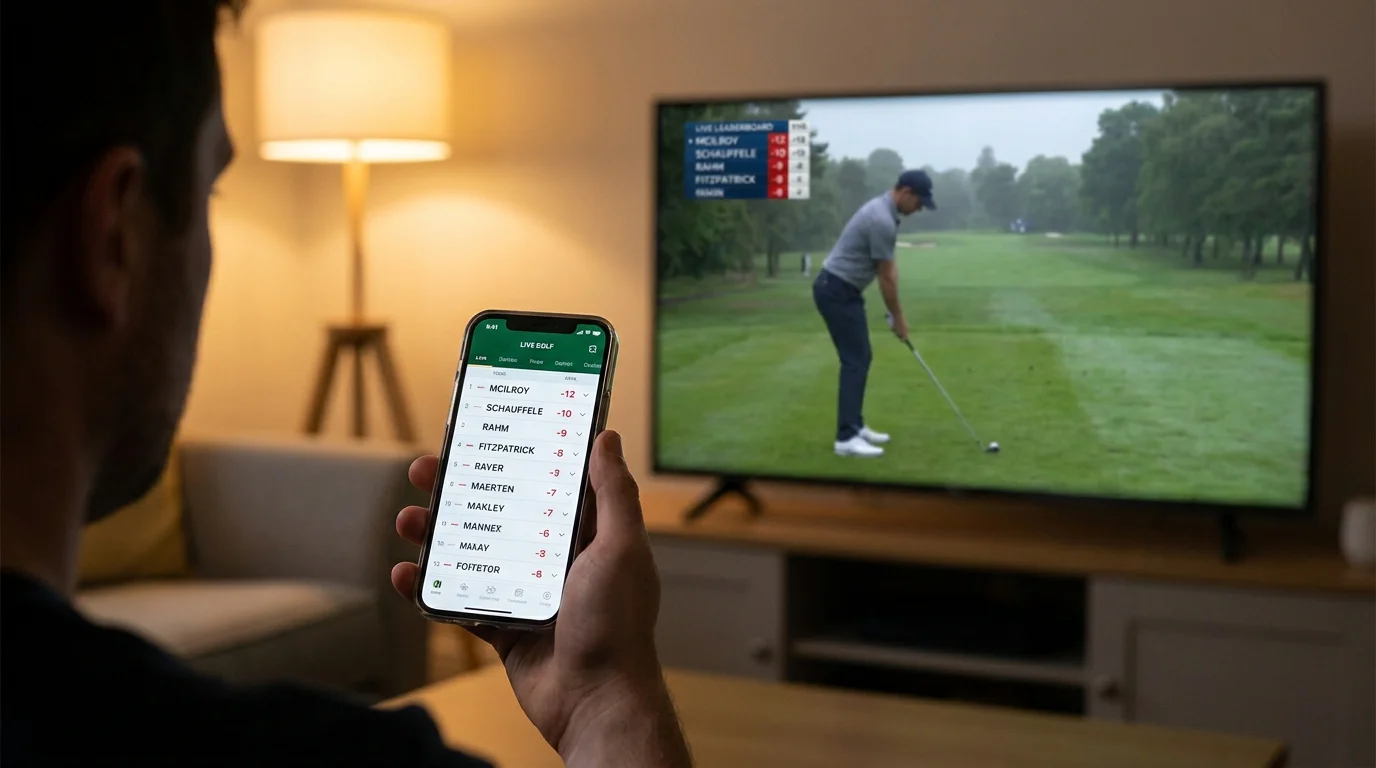
Here is the mechanic. UK books license shot-by-shot data from IMG Arena, which holds the official PGA Tour partnership. That feed lands at the bookmaker, gets parsed, and the in-play price updates. The cycle has been measured at around five minutes from shot to revised odds during normal-paced rounds. If you are watching the live broadcast — or, better, watching the leaderboard on the Tour’s own app — the board has a structural lag you can use, especially when a tournament leader has just dropped a shot off the eighteenth and a 30/1 outsider has just stuffed a wedge to two feet.
Live golf carries its own family of markets: current round leader, top-five after R3, head-to-head for the lap, and hole-by-hole props on the live menu. Most UK books also keep the outright open until the leader tees off the final round, which is where some of the most asymmetric prices of the week sit. The £596 million in Q1 2025 online real-event betting GGY — up 5 percent year on year — has live golf in its share, even if the books do not break that line out.
Do
- Have the live tournament leaderboard open on a second screen before any in-play stake.
- Watch for a leader’s bogey on a holed-back tee group — outrights and top-5 prices lag the leaderboard reflection.
- Stick to deep markets — outright, top-5, head-to-head for the round, current round leader.
- Set a per-session stake cap before the round and walk away when you hit it, win or lose.
Don’t
- Live-bet a tournament you have not watched at least one round of. The leaderboard is a story; do not jump in at chapter ten.
- Chase specialty markets — hole-in-one props, winning margin — at the live price. The margin is too wide.
- Place a live stake without first checking the live cash-out price against the implied probability.
- Treat the five-minute window as permanent. It will close as the feed gets faster.
The same tournament looks different to a beginner, an intermediate and a sharp
There is no single “right” way to bet golf, and most arguments I have with friends over a Sunday Open final boil down to this: we are operating at different points on the learning curve and we are using different mental tools to do the same job. A first-month punter who tries to copy a model-builder’s plays is, in nine cases out of ten, going to torch their bankroll. A sharp who tries to talk themselves into a 4/1 favourite is, in nine cases out of ten, lighting money on fire for sentimental reasons.
So here is the way I think about the three honest tiers, and what each one actually does on the betslip.
| Profile | Beginner | Intermediate | Sharp |
|---|---|---|---|
| Bet types | Small outright stakes at 25/1 or longer, taken each-way with a 1/5 fraction over 7 or 8 paid places. One or two bets per event. No in-play for the first month. | Two-ball matchups and top-10 finish markets layered onto a smaller outright play. Tracks recent form across last six to ten rounds rather than season totals. | First-round leader and group-winner markets driven by SG-model outputs. Explicit course-fit angles. Live cash-out treated as an arbitrage tool, not a defensive measure. |
| Stake sizing | Roughly 1 percent of bankroll per outright; never more than 5 percent total exposure on a single tournament. | Up to 2 percent per matchup or top-10 bet, with bet-builder combinations capped at 0.5 percent. | Variable position-sizing based on edge percentage from the model. Willing to pass entire events when the slate does not produce an edge. |
| Avoids | Head-to-head matchups, specialty props, bet-builders, live in-play, ante-post markets longer than a fortnight out. | Live-arb attempts, specialty props priced above 50/1, ante-post longer than three months out. | Emotional bets, favourite-following without an angle, books with thin live menus and weak each-way terms on majors. |
The honest line between tier two and tier three is not knowledge — it is discipline. A sharp who cannot pass on an event when the data tells them to pass is, functionally, an intermediate with a model open. The skill is sitting on your hands. The version of me who first found Strokes Gained would never have believed that.
What I run through before clicking confirm
The most expensive Open ticket I have ever placed was the one I did not check against my own checklist. I knew the golfer had played a single competitive round on links since the previous Open. I knew the forecast had two thirty-mile-an-hour gusts. I knew his SG: Putting numbers on bentgrass were not transferable to fescue. I backed him anyway because he had won the week before. He missed the cut by four.

I do not stake a golf bet of size without running through six items. They take less time than reading the cover of the bookmaker’s promo email, and they have saved me more money than any model output I have ever produced.
Six checks I run before any golf stake of size
- Course-fit angle: does the layout reward the golfer’s two dominant Strokes Gained channels, and have they performed on similar layouts in the last 24 months?
- Recent form window: not last season’s totals, but the last 24 rounds. Anything outside that window I treat as background information, not a price input.
- Weather window: which wave is the golfer in, what is the wind forecast for that wave, and is there a meaningful chance of a single-tide disadvantage versus the other half of the field?
- Each-way terms: number of paid places and fraction. The same name at 25/1 with 8 paid places at 1/5 is a very different proposition from the same name at 22/1 with 5 paid places at 1/4.
- Bankroll percentage: this stake against my remaining annual bankroll, never above 2 percent on outrights, 1 percent on top-finish, 0.5 percent on specialty.
- Responsible-play setup: my deposit-limit is current and my session timer is set. No bet on autopilot.
Data Golf’s research shop runs around 60,000 simulations per prediction, with a 2σ simulation error of 0.4 percent on 50 percent probabilities and 0.24 percent on 10 percent probabilities. The point of a checklist is not to outperform a sim that big. It is to prevent you from being the variable that ruins what the model already got right.
How to judge a UK book on its golf shop, not its football
Here is the question I get asked most often by friends new to UK golf betting: “who is the best book?” Here is the answer I have learned to give: that is the wrong question. The right one is “what does a UK book need to do well in golf, and which boxes have you actually checked?”

Football and horseracing are deep enough markets that the cosmetic differences between operators do not matter much. Golf is not. The way a UK book handles each-way places, the speed of its live menu, and the small print on its dead-heat handling — those decisions add up to a measurable swing in your end-of-year P&L.
| Criterion | Why it matters for golf | What “good” looks like |
|---|---|---|
| Each-way places on majors | Determines how often a longshot pays at all. The single biggest expected-value driver in the golf shop. | 8 to 10 paid places at 1/5 on all four majors, with extra-place promotions offered. |
| Each-way fraction on standard events | Affects the place return on every non-major bet — the bulk of weekly volume. | 1/5 across the board, not 1/4 on PGA Tour standard events. |
| First-round leader market depth | FRL is one of the few markets where the public price routinely overshoots; depth widens the available value. | Priced on every entrant in the field, not just the top 40 by OWGR. |
| Live-betting menu and cash-out | The five-minute data window is your edge — the menu has to be wide enough to use it. | Round-leader markets, top-5 after R3, hole-by-hole props, transparent cash-out value. |
| Dead-heat clarity | Tie reductions can swing a return by 50 percent or more. The T&Cs need to say how the rule is applied, not just that it exists. | A worked example in the help section, accessible without logging in. |
UK PPC market share for sports betting tells you which books spend most on visibility, not which are best for golf. As of May 2026 the click-share leaders were Ladbrokes at 31.23 percent, Sky Bet at 17.97 percent and William Hill at 9.36 percent. Click share is a marketing metric. The golf shop is somewhere downstream of that.
One piece of macro context worth keeping in mind: UK horseracing levy income hit nearly £109 million in the year to March 2025 — a record since 2017 — and yet racing’s total betting turnover dropped over the same period. The horseracing exemption from the new Remote Betting Rate is a political fact, not a sporting one, and it explains why golf book margins are about to compress harder than racing’s. You read that compression on your betslip in the size of the place pool and the size of the extra-place promotion. Watch those numbers as the calendar turns into spring 2026.
The integrity machinery you do not see
Every betting market lives or dies on the question of trust, and golf has a particular vulnerability built into the format: it is, in principle, easier to nudge one player than to compromise a team. The honest answer to that worry is not “it could never happen” — it is the architecture set up to catch it when it does. The PGA Tour’s Integrity Program, IC360 and Genius Sports together monitor every wager taken on a Tour event, line up the betting data with shot-by-shot performance, and ask the question algorithmically every week.

The architecture matters because it is the difference between a betting market that can be trusted and one that cannot. Andy Levinson, the Tour’s senior vice president of tournament administration, frames the point bluntly: “We’re not immune to the potential for corruption, we’re not immune to bad actors, all that. That exists and that threat is always gonna be there. So the first and foremost thing is — everything we do in this space is integrity first.” When the man overseeing the operation talks like that, it tells you something about how seriously the cap is welded on.
UK punters benefit from the same architecture without paying for it. Shot-by-shot data feeds the bookmaker. The bookmaker’s pricing system feeds the integrity scan. The integrity scan flags anomalies back to the Tour. Three independent commercial parties all incentivised to make sure the prices reflect the actual game.
The grey-zone story is where it gets interesting. Prediction markets — Kalshi and Polymarket are the names UK punters keep hearing — have started listing event-style golf contracts. The CFTC, not the UK Gambling Commission, sits over those products in the United States, and the Tour’s position has been distinctly nervous. Levinson again, in a separate exchange: “The CFTC is not a betting regulator, and yet they’re governing prediction markets right now. So, either they add a skill set or add some language to the CFTC that protects us a little bit better.” Translated, that is the Tour asking whether the operator on a prediction market should have the same integrity obligations as a UK-licensed sportsbook. Right now, in any meaningful sense, it does not.
Holding your nerve and your bankroll
I have voluntarily taken time-outs from my own account twice in the last five years, both times because the cadence of golf — week after week, no off-season — was nudging me towards behaviour I did not like. There is nothing professional about pretending those moments do not exist. They are part of the job.
The publicly available numbers say the same thing about the wider population. GambleAware’s most recent treatment and support survey found that more than 5 million UK adults wanted to either cut down or stop betting altogether. Among 18 to 34 year olds who gamble, 30 percent said the same. The Problem Gambling Severity Index returned a “1 or higher” score for 16 percent of UK adults — up from 13 percent a year earlier — and roughly 4.3 million people were classified as “affected others” whose lives were touched by someone else’s gambling habits.
The UK-licensed tools that work are the ones built into your bookmaker account, not the ones you have to go looking for. Set a deposit limit before your first stake, not after the first losing month. Use the session-time reminder. Activate self-exclusion through GAMSTOP if the deposit-limit conversation has become an argument with yourself. The infrastructure is there. The only question is whether you turn it on.
Two practical edges I want flagged. First: affordability checks, the £150 net-deposit trigger, are not the same thing as a “limit.” They are a regulator-mandated check on the licensed market. If you find yourself irritated by them, that is itself a useful signal — the irritation, not the depositing, is the part worth examining. Second: the UK’s National Gambling Helpline is free and confidential, available around the clock, and the call costs nothing. The single best edge in this business is the one that says “not today” before any spreadsheet does.
A UK punter’s year on the golf calendar
The year for a UK golf punter does not run January to December. It runs Hero World Challenge to FedExCup Finals, with the Ryder Cup or Solheim Cup playing the role of biennial Christmas. Internalise that calendar and you will instinctively know when to push on volume and when to coast.
December to March
Hero World Challenge through the Players. Low-key opening run, with TGL — Tomorrow’s Golf League — now part of the betting menu. TGL’s January 2025 debut drew 3.2 million unique viewers across the evening, with a 1.2 million average and a 1.41 million peak.
April to July
The majors run: The Masters, US PGA, US Open, The Open. Roughly two-fifths of annual golf turnover, with the deepest each-way places of the year showing up on The Open’s board.
August to early September
FedExCup playoffs. Tour Championship caps the season, with progressively shrinking fields concentrating top-finish value into a tighter and tighter window.
Late September, biennial
Ryder Cup or Solheim Cup. Team format flips the entire pricing logic. In off years, the DP World Tour finale fills the slot.
What is changing in 2026 is the TGL contribution to the calendar. The league’s median viewer age is 51 — younger than NHL at 52, F1 at 53, NFL at 54 and MLB at 60 — and the betting menu is settling into hole-by-hole and hammer-challenge markets that have no real PGA Tour parallel. For a punter who hates the dead weeks between the Players and the Masters, TGL has quietly closed the gap.
Ten words you will keep meeting
You will hear the same shortlist of words on every UK golf betting podcast, in every operator’s help section, and in every conversation between punters waiting for tee-off. Here are the ten worth knowing before the next one starts.
Outright — the bet on the eventual tournament winner across all 72 holes.
Ante-post — a bet placed before the field is finalised, often months in advance, at longer prices but with no stake refund if your runner withdraws.
Each-way — a paired bet, half on win and half on a finishing place, with the place portion priced at a fraction of the win price.
Dead heat — what happens when two or more golfers tie for a paid finishing position, triggering a proportional reduction of the place stake.
First-round leader, or FRL — a bet on whoever leads at the end of the first competitive round.
OWGR — the Official World Golf Ranking, the headline aggregate measure most book pricing references.
SG: Approach — the Strokes Gained sub-metric covering approach shots into greens, the single best predictor of major-week performance.
Hammer — the TGL-specific challenge mechanic that doubles the stakes on a hole mid-play; betting markets follow accordingly.
Claret Jug — the trophy lifted at The Open Championship, the lone men’s major held outside the United States.
ATC — advance ticket commitment, a PGA Tour player’s pre-season schedule pledge, useful for ante-post ranking purposes.
Questions UK punters keep asking me about golf betting
Is golf betting legal in the UK?
Yes, with the usual caveats: every UK-licensed bookmaker requires you to be 18 or older, and you must hold an account with an operator that has a UK Gambling Commission licence. Since February 2025, depositing more than £150 of net funds across a thirty-day window will trigger a light-touch affordability check. The check is not a refusal — it is a regulator-mandated request for source-of-funds evidence such as bank statements or payslips. Bet through a licensed operator and the legality question is settled. Bet through an offshore site and you have no recourse if anything goes wrong.
What does each-way mean in golf betting?
It is two stakes welded together — half on the win, half on a finishing place. The place portion is priced at a fraction of the win price, typically 1/4 or 1/5 in UK golf, and pays out across a defined number of finishing positions, usually 5 to 10 depending on the event and the operator. A £10 each-way is therefore a £20 outlay. For the full breakdown of fractions, dead-heat reductions and extra-place promotions, our each-way guide walks through every variant with worked examples.
How does the dead heat rule work in golf?
When two or more golfers tie for a finishing position that pays each-way, the stake on the place portion gets reduced proportionally. The formula is straightforward: your effective place stake equals your original stake multiplied by the ratio of paid positions remaining at the tied finish to the number of golfers tied. Three golfers tied for what would be the seventh paid position split that final place between them — so your £10 each-way on one of them returns one-third of what it would on an outright seventh. The deep mechanics live in the each-way cluster.
What is the most popular golf bet?
By volume across a UK book, outright each-way is the working answer. The bet’s structure — small stake, longshot price, paid out across 5 to 10 places — fits the variance profile of a 156-player tournament neatly. First-round leader sits in second place for sheer ticket counts, especially during majors, because it offers a single-day, high-variance market that does not require the punter to commit to 72 holes of opinion. Top-10 finish bets sit third by volume but climb closer to outright each-way once you weight by stake size rather than ticket count.
How are golf odds calculated?
UK golf books default to fractional pricing — 20/1, 33/1, 100/1. The fraction shows the ratio of profit to stake: a winning £10 bet at 20/1 returns £200 in profit plus your £10 stake back, for a total of £210. Books arrive at each price by combining world-ranking data, recent form, course-fit modelling and the public’s betting flow, then loading their margin on top. Each-way prices add a second calculation on the place portion using the fraction applied to the win price.
What is the best way to bet on golf for beginners?
Small outright each-way bets at 25/1 or longer on events that pay 7 to 10 places at 1/5 fraction, no more than one or two bets per week, and absolutely no in-play for the first month. Pick events you would watch anyway, set a deposit limit before your first stake, and use the bet-tracker built into the app to record what worked and what did not. The first goal is not to win — it is to learn how the structure pays and how the line moves between Tuesday opening prices and Thursday tee-off.
Five threads from this guide worth pulling
That is the working map for golf betting in the UK in 2026 — markets, each-way structure, majors, data, regulation, live mechanics, bookmaker selection, integrity, responsible play and the calendar that holds it all together. If a single section sent you down a rabbit hole, the five deeper guides linked throughout this piece — on the full market list, each-way mechanics, the majors, Strokes Gained and UK regulation — are where the working detail lives. Pick the thread that nudged you the hardest and keep reading. The next bet, the one with the better outcome, is always the one you have not yet placed.
Prepared by the Golf bet editorial staff.