LIV Golf Betting Markets: What UK Bookmakers Actually Offer
 Available in US

I started covering LIV Golf in 2022 expecting it to be a footnote. Four years on, it’s a genuine third leg of the betting calendar — most weeks during the LIV season, I’m putting more time into the team markets than into the PGA Tour stop. The format is so different from anything else in professional golf that UK firms have spent the entire run since 2022 catching up on how to price it. This piece is what UK punters actually find when they pull up the LIV menu, where the markets are honest, and where they’re still finding their feet.
Table of Contents
- 54 holes, shotgun starts and what that means for prices
- Individual outright and the field-size question
- Team markets and the strategic depth
- No-cut format and how it changes place strategy
- Data availability for LIV bettors
- Liquidity and margin compared to PGA Tour weeks
- What to actually bet on a LIV weekend
54 holes, shotgun starts and what that means for prices
A reader asked me last summer why his LIV outright bets seemed to settle so much faster than PGA Tour bets. The answer is the format. LIV events run 54 holes with no cut, shotgun start, and team play running parallel to individual competition. That structural compression — three rounds instead of four, all players starting at the same time, everyone in the field finishing the event — changes the betting maths in ways the casual punter doesn’t always pick up.
UK online betting through Q1 2025 reached £596m, up around 5 percent year-on-year, and LIV events have started to pull a noticeable share of golf-specific handle on UK weekend Saturdays. That handle goes to a different set of markets than the PGA Tour equivalents — the team market is the headline feature, and individual outright betting is the secondary product rather than the main act.

The 54-hole format compresses variance. Three rounds give the field fewer chances to separate, which means leaderboards tend to bunch tighter at the top and the each-way pool is shallower than at a PGA Tour event. The shotgun start eliminates the morning-versus-afternoon wave that drives so much PGA Tour pricing — every player gets the same conditions on each day, which removes a whole layer of pricing complexity.
Individual outright and the field-size question
The LIV field runs 54 players spread across 13 teams of four, with two non-team additional spots. That’s a smaller field than a Major and significantly smaller than a regular PGA Tour event. The implied probabilities at the top of the outright market are accordingly higher — favourites are typically shorter and the longshot tail is shorter too.
That changes my each-way strategy. UK firms usually offer five or six places at 1/5 for LIV individual outrights, sometimes four places. Compared to the eight or ten places you see at PGA Tour events with similar headline odds, the LIV place market is meaningfully tighter. The break-even maths on a 50/1 each-way bet at LIV doesn’t work as cleanly as the same odds on tour.

The flipside is that outright pricing on the favourites is sharper. Without a 156-player field to spread the book across, UK firms have to take a more confident view on the top six or seven names. I’ve found that translates into outright prices on top-tier LIV players being closer to fair value than the equivalent PGA Tour outright prices, where there’s more cushion in the book.
Team markets and the strategic depth
Team golf is where LIV pricing gets genuinely interesting. Each event runs a team competition in parallel to the individual one — two scores per team count on Friday and Saturday, three scores count on Sunday, with the lowest aggregate team score winning. UK firms typically post outright team winner, team head-to-heads, top team from each region, and a winning-team-by-margin band.
The team market doesn’t behave like the sum of its individual parts. A team of four players ranked 1st, 10th, 25th and 35th on the individual board doesn’t necessarily beat a team of four players ranked 5th, 8th, 15th and 20th — the variance of the four-player aggregate matters more than the top player’s ceiling. UK firms have improved at pricing this since 2022 but the team market still rewards the punter who has actually run the four-score aggregate maths.

I’ll often bet a team head-to-head when the implied team probabilities don’t match the individual probabilities of the four players. The discrepancy is usually small — 3 to 5 percent — but it’s persistent enough to be worth tracking.
No-cut format and how it changes place strategy
The no-cut format at LIV events is one of the structural changes that most affects betting strategy. With every player guaranteed to finish 54 holes, there’s no make-the-cut market — that whole product category just doesn’t exist at LIV. The make-the-cut money in the PGA Tour week migrates to other markets at LIV events.
Where does it go? Mostly to top-25 and top-10 finish markets, which UK firms price more liberally for LIV than for the PGA Tour. The smaller field means the implied probability of any individual player making the top 25 is meaningfully higher — at a 54-player field, the top 25 is roughly the top 46 percent, which is a different bet than the top 25 in a 156-player PGA Tour field. UK firms have generally caught up to this maths, but the prices on mid-priced players in the 25/1 to 50/1 band can still drift wider than the field-size adjustment warrants.
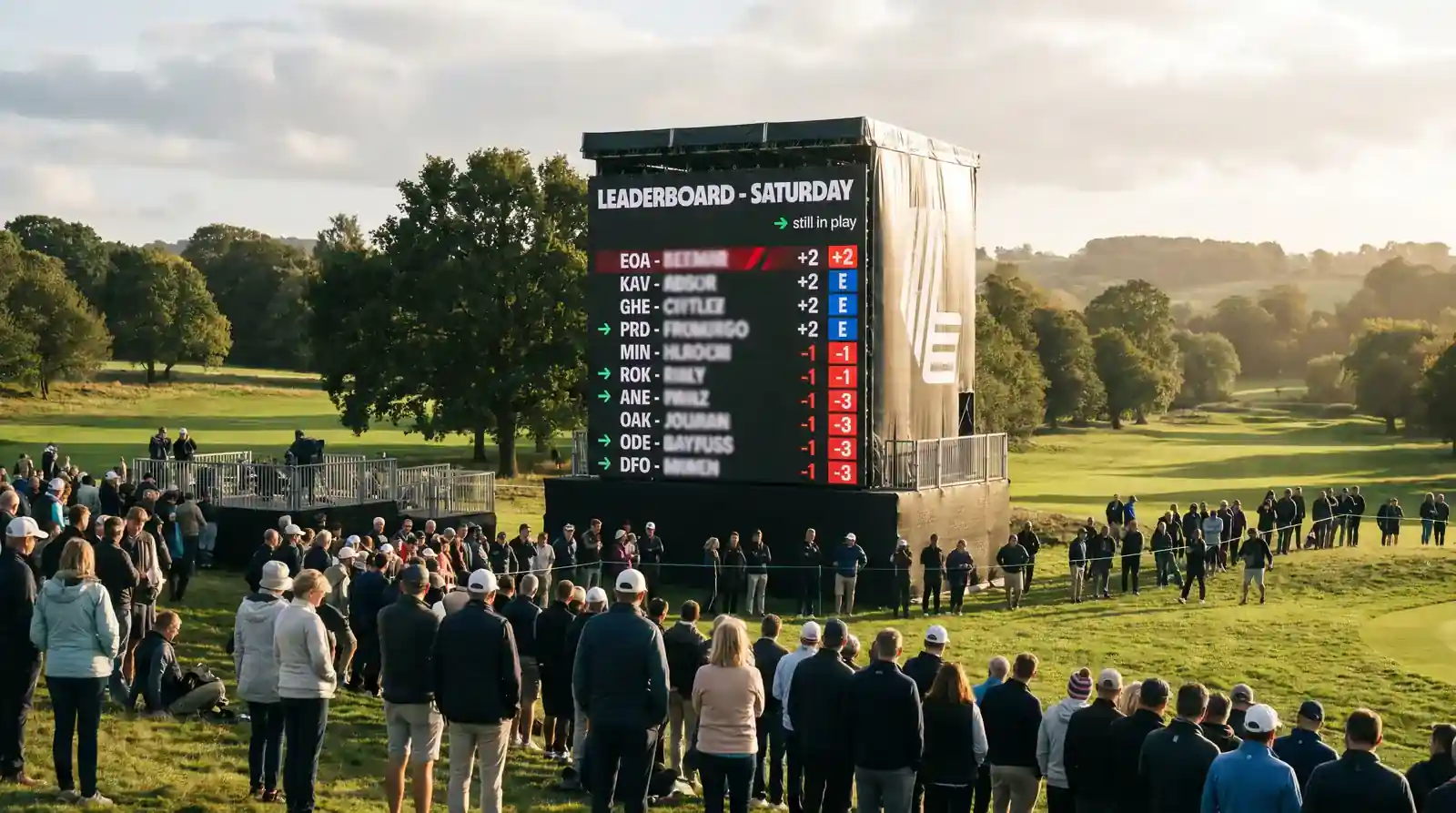
Round-leader markets also change because the shotgun start means there are no overnight leaders in the traditional sense — every player completes 18 holes at roughly the same time. That makes the round-leader market more of a single-round outright than a wave-driven product. Pricing is sharper as a result.
Data availability for LIV bettors
The single biggest betting handicap at LIV events is data scarcity. The PGA Tour publishes detailed strokes-gained breakdowns; LIV does not. Independent analytics providers have started filling the gap, but the coverage is thinner and the comparability with PGA Tour data is imperfect because the player pool overlaps only partially.
That’s where I rely on third-party modelling. The broader case for serious analytical inputs is something I’ve covered in my piece on the DataGolf model, and the LIV-versus-PGA data gap is exactly the kind of problem those models exist to handle. Independent analytics rebuild strokes-gained estimates from raw scoring data, which is more reliable for LIV than waiting for an official equivalent.

The data limitations have a practical effect on my LIV betting. I size positions smaller at LIV events than at PGA Tour events because my own confidence intervals are wider. The same margin of edge feels less robust when the underlying data is patchier.
Liquidity and margin compared to PGA Tour weeks
Liquidity at LIV events runs at roughly 25 to 40 percent of a comparable PGA Tour week in the UK market, based on my own tracking of price movement and book limits. That’s a substantial gap, and it shows up in higher bookmaker margins. LIV outright markets typically run 105 to 108 percent overround in the UK; PGA Tour equivalents sit between 103 and 106 percent.
Higher margin means flat-stake betting needs a wider edge to be profitable. The compensating factor is that the team markets — with their pricing complexity — often have softer prices than the standard overround would suggest. I find more value in LIV team head-to-heads than in LIV individual outrights, because the team-pricing models are still maturing.

Bookmaker limits at LIV events are also meaningfully lower than at PGA Tour events. For most UK punters that doesn’t matter — the stake size never approaches the limit anyway — but for anyone running larger positions, the lower limits at LIV stops are worth noting.
What to actually bet on a LIV weekend
My honest LIV playbook is shorter than my PGA Tour playbook. The markets I’ll consistently bet are: team head-to-heads where the four-player aggregate maths shows a discrepancy with the individual board, individual outright on the top five or six contenders when the price reflects field-size adjustment, and round-leader on Sunday when one or two players have separated by Saturday evening. The markets I’ll generally avoid are the prop markets where pricing is thin and the longshot individual outrights where the place pool is too tight to justify the each-way.
The LIV product is still finding its commercial footing in the UK market. The pricing improves with each season but the data gap and the format-specific quirks mean it requires its own approach rather than a translation of PGA Tour methods. Treat it as a separate event type, size positions accordingly, and the team markets in particular will keep paying for the homework.
Most major UK bookmakers now post LIV Golf markets, but the depth varies significantly. All major books cover the individual outright. Coverage of team markets, head-to-heads and round-by-round propositions is patchier — some books post only the individual outright and a single team market, while others offer 20 or more LIV-specific markets each week. LIV individual each-way typically pays five or six places at 1/5 the odds, sometimes four places at 1/4. The smaller place count reflects the 54-player field. Each-way maths at LIV is meaningfully tighter than at PGA Tour events because the field is smaller and the place pool stretches less far down the leaderboard.Are LIV Golf markets available at all UK bookmakers?
How does each-way betting work on LIV events?
Created by the ”Golf bet” editorial team.