
Fractional vs Decimal Odds for Golf Bettors: Why UK Books Still Show 25/1
 Available in US
I spent my first three years of golf betting reading prices as fractions and never bothering with the conversion to decimals. Then I started using probability models and realised that decimals were doing all the maths I needed and fractions were just a presentation choice. UK bookmakers still default to fractional display because UK bettors expect it, but the right format for the punter depends on what kind of bet you’re placing and what you’re trying to calculate. This piece is the short tour of why both formats persist, how to convert between them quickly, and why decimal odds matter more for serious analytical work than fractional odds do.
Table of Contents
- Fractional basics and the British heritage
- Decimal basics and the European standard
- Implied probability and why decimals win
- American format and the third option
- Conversion cheat sheet for golf-specific prices
- Which format to use for which kind of work
- Calibrating intuition across formats
- Why both formats persist for UK golf bettors
Fractional basics and the British heritage
A reader asked me last summer why UK bookmakers still show prices as fractions when the rest of the world has moved to decimals. The honest answer is heritage. UK bettors have read fractional odds for over a century, and the format conveys information in a way that’s intuitive for stake-and-return calculations even if it’s awkward for probability work.
A fractional price of 25/1 means: stake one unit, win 25 units of profit if successful. A 25/1 bet at £10 stake returns £250 profit plus the £10 stake — total return £260. That’s straightforward and matches how casual punters think about a bet. The mental shortcut is “if I win, I get back the stake plus this much profit per unit staked.”

The complication starts with fractions that aren’t single digits over one. A price of 11/4 means 11 units of profit for every 4 units staked — £10 at 11/4 returns £27.50 profit plus the £10 stake. The mental maths gets harder fast. Prices like 11/4, 7/2, 13/8 and 4/9 are routine in golf betting, and the conversion to total return takes a moment of arithmetic for anyone who doesn’t deal in fractions every day.
Golf betting still uses some of the longest fractional prices in any sport. A 200/1 outright on a Major longshot, a 1000/1 outright on a Q-school graduate — these prices are common on weekly outright boards and they’re displayed in fractional form by every major UK firm.
Decimal basics and the European standard
Decimal odds express the total return per unit staked, including the stake itself. A decimal price of 26.00 returns 26 units total — 25 units profit plus the 1 unit staked. That’s the same bet as 25/1 in fractional form. The conversion is straightforward: fractional 25/1 equals decimal 26.00, fractional 11/4 equals decimal 3.75, fractional 4/9 equals decimal 1.44.
The decimal format dominates in continental Europe, in betting exchanges, and in any analytical context where multiple odds need to be combined or compared. The reason is mathematical: decimal odds multiply cleanly. A two-bet accumulator at 2.00 and 3.00 returns 6.00 per unit staked. A three-bet accumulator at 2.00, 3.00 and 4.00 returns 24.00 per unit staked. The same calculation in fractional form requires conversion to decimals or careful tracking of the implied returns at each step.

UK firms typically allow customers to switch between fractional and decimal display in their account settings. The price boards in the bookmaker app show whichever the customer prefers. For analytical work I keep decimals on; for casual stake calculation I sometimes switch to fractions. The choice is purely about which format fits the calculation you’re doing.
Implied probability and why decimals win
The single best argument for decimal odds is implied probability. Decimal odds convert to implied probability with one operation: divide 1 by the decimal price. A 4.00 price implies 0.25 (25 percent) probability. A 2.50 price implies 0.40 (40 percent) probability. A 26.00 price implies 0.0385 (about 3.85 percent) probability before correcting for bookmaker overround.
The same calculation in fractional form requires two operations: convert fractional to decimal first, then divide. The maths is identical but the path is longer. For a punter checking dozens of prices across multiple firms, that extra step adds up. The probability work that underpins serious betting analysis runs on decimal odds because the conversion to implied probability is direct.

The UK golf betting market hosted around 13.5 million monthly active online betting accounts in 2025, and the analytical sophistication of those accounts varies wildly. Punters running probability-based approaches benefit from decimal odds; punters running gut-feel approaches do fine with fractional odds. The choice is about workflow rather than about which format is fundamentally better. The broader framework for using probability against bookmaker prices sits in my piece on the DataGolf model, which depends heavily on clean decimal-to-probability conversions.
American format and the third option
American odds are the third format UK punters occasionally encounter, particularly when looking at US-focused golf coverage or transferring information between betting communities. The format is based on $100 reference units: a price of +500 means winning $500 on a $100 stake, while a price of -200 means staking $200 to win $100.
American odds are awkward for international comparison because they switch between the two conventions at the implied 50 percent probability point. Anything shorter than even-money uses the negative format; anything longer than even-money uses the positive format. The conversion to decimal is two-rules: positive American odds divided by 100, plus 1; negative American odds is 100 divided by the absolute value, plus 1.

For UK punters, American odds matter mostly when reading US sportsbook coverage of golf events. Scheffler at +500 to win the 2025 Open is the same bet as 5/1 fractional or 6.00 decimal. The conversions are simple but worth knowing if you read US betting analysis or compare prices across international platforms.
Conversion cheat sheet for golf-specific prices
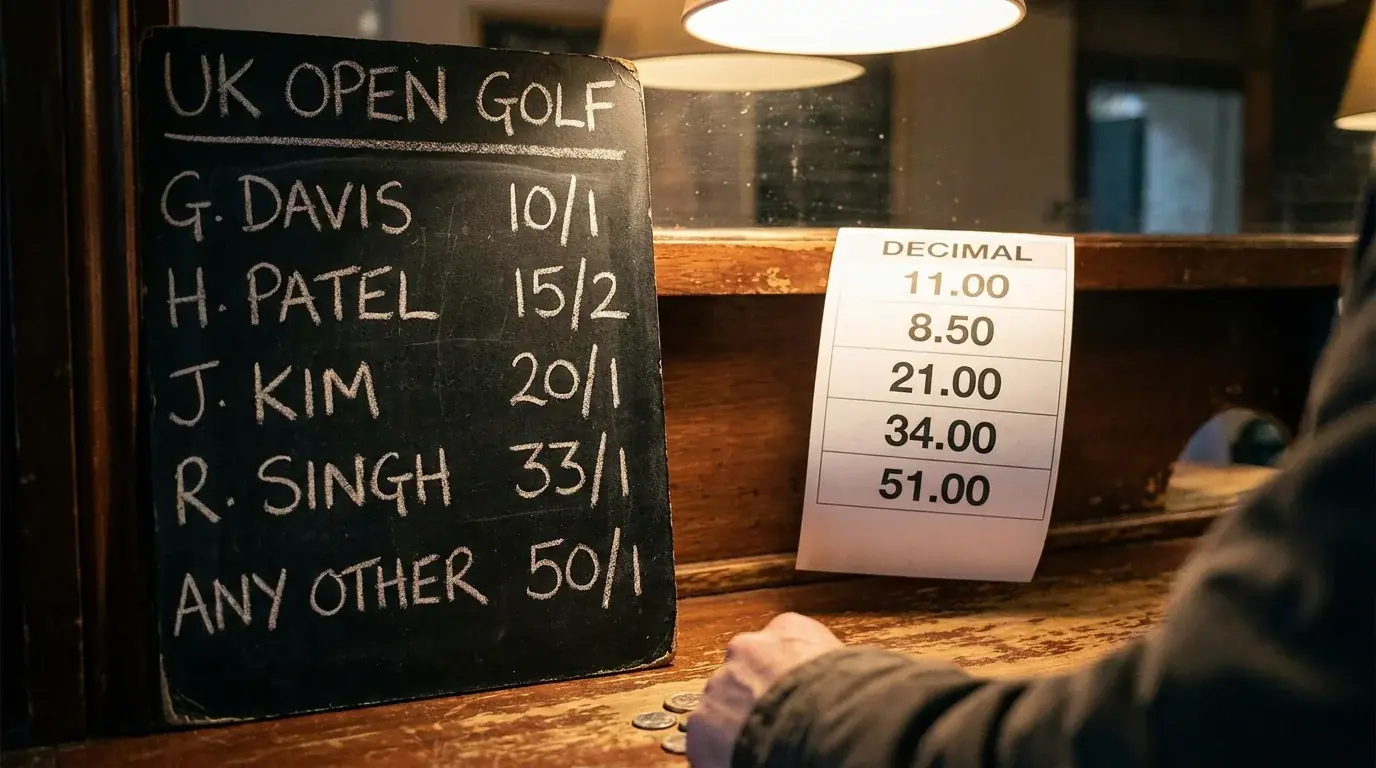
The fractional prices most common in golf outright betting and their decimal equivalents are worth committing to memory. 6/1 is 7.00, 8/1 is 9.00, 10/1 is 11.00, 12/1 is 13.00, 14/1 is 15.00, 16/1 is 17.00, 20/1 is 21.00, 25/1 is 26.00, 33/1 is 34.00, 40/1 is 41.00, 50/1 is 51.00, 66/1 is 67.00, 80/1 is 81.00, 100/1 is 101.00. The pattern is simple — add one to the fractional X/1 to get the decimal equivalent.
Each-way fractions deserve their own conversion table. The standard place fractions are 1/4, 1/5 and 1/8. To calculate the place return on a 25/1 each-way bet at 1/5, the place price is 25 divided by 5 — that’s 5/1 fractional or 6.00 decimal on the place side. A 100/1 each-way bet at 1/5 pays the place at 20/1 fractional or 21.00 decimal. The arithmetic is the same in either format but the fractional convention is what UK firms display.

Some golf-specific prices use unusual fractions. 11/4, 13/8, 9/2, 11/2 — these appear on shorter-priced favourites and matchup markets. The decimal equivalents are 3.75, 2.625, 5.50 and 6.50 respectively. Memorising the common fractional-to-decimal conversions saves significant mental load when comparing prices across multiple firms during a busy outright market.
Which format to use for which kind of work
My practical rule is to use whichever format makes the current calculation easiest. Quick stake-and-return checks on a single bet are easier in fractional form — 1 unit at 25/1 returns 26 units, no further maths needed. Probability comparisons across multiple bets are easier in decimal form — implied probability calculations and overround stripping run on decimal numbers.
For accumulator and bet-builder work, decimal form is essential. A four-leg golf bet builder at 2.50, 3.00, 4.00 and 1.50 multiplies to a combined decimal of 45.00 — that’s the total return per unit staked. Trying to combine 6/4, 2/1, 3/1 and 1/2 in fractional form requires conversion to decimal anyway, so most bet-builder displays show the combined price as a decimal regardless of the individual leg display.

For golf each-way work, fractional form is more intuitive because the place fraction is itself a fraction. “25/1 at 1/5 eight places” reads naturally in fractional terms. The same bet in decimal terms requires explaining that the place leg pays 6.00 decimal because 25 divided by 5 plus 1 equals 6, which is more cumbersome.
Calibrating intuition across formats
The single most useful intuition for UK punters is the rough probability-to-odds mapping. Even money is 50 percent probability — 2.00 decimal or 1/1 fractional. 33/1 is roughly 2.9 percent probability — 34.00 decimal. 100/1 is roughly 1 percent probability — 101.00 decimal. 200/1 is roughly 0.5 percent probability — 201.00 decimal.
Holding those reference points in mind allows quick sanity checks on whether a price feels too short or too long. If a 100/1 outright price implies 1 percent probability and the punter’s own assessment is that the player has 2 percent chance, the price represents a meaningful edge. If the assessment is 0.5 percent, the price is too short.
Sportsbook overround typically adds 5 to 9 percent to the sum of implied probabilities across a market. A market priced at 105 percent overround means the bookmaker is taking roughly 5 percent margin across all outcomes. Decimal odds make that calculation straightforward; fractional odds require conversion. For any UK punter doing serious analytical work on golf prices, learning to think in decimals while reading fractions is the practical compromise that produces the best of both formats.
Why both formats persist for UK golf bettors
The honest answer about the two formats is that neither will replace the other in UK golf betting any time soon. Fractional odds carry the cultural weight of British betting history and they’re intuitive for casual stake calculation. Decimal odds carry the analytical weight of modern probability work and they’re essential for any betting approach that compares prices to model probabilities. The best UK punters I know are fluent in both, switching seamlessly depending on the task. Reading fractional odds at the price board, doing the probability work in decimals, taking the price that offers the better implied probability — that’s the workflow that gets the best of both formats and produces betting decisions that hold up over a long season.
UK bookmakers default to fractional odds because UK bettors have read them for over a century and the cultural expectation is set. The format is intuitive for stake-and-return calculation on a single bet and matches the way casual punters think about a wager. Most UK firms now allow customers to switch to decimal display in account settings, but the default remains fractional because most bettors expect it. No, the formats are mathematically identical — they express the same implied probabilities and the same returns. Decimal odds can display prices that fractional form rounds, like 3.75 versus the closest fractional 11/4, but the difference is presentation rather than accuracy. For probability calculations and accumulator work, decimal is more convenient; for single-bet stake calculation, fractional is more intuitive.Why do UK bookmakers default to fractional odds?
Are decimal odds more accurate than fractional odds?
Created by the ”Golf bet” editorial team.