Cash Out on Golf Bets: When to Lock In, When to Let It Ride
 Available in US

Cash-out is the most psychologically loaded button on a UK bookmaker’s app. Everyone has the same memory — the time you cashed out for £80 with two holes to play and watched your man bogey 17 to finish T6. Everyone also has the opposite memory — the time you held the ticket through Sunday afternoon convinced your 50/1 longshot would hang on, and watched a triple bogey on the 16th green erase three days of patient hoping. Cash-out is genuinely an embedded lay-off market on your own position. After nine years of watching its mechanics evolve across UK operators, I can tell you the rule is not “always take it” or “always hold it” — it’s a calculated decision based on the offered price relative to the residual fair value, and the discipline to take that decision without sentiment attached. The maths is simpler than the emotion makes it feel.
What Cash-Out Actually Offers You
The mechanic is direct. While your bet is still live, the bookmaker quotes a price at which they’ll settle the ticket immediately rather than waiting for the official outcome. Accept the price, the ticket settles for that amount, and the position is closed. Decline, the ticket remains live until the official result.
The price quoted is structurally below the fair value of the remaining position. The operator builds a margin into the cash-out figure — typically 5 to 10 per cent for outright golf positions, occasionally tighter on shorter-priced bets and wider on longshots. The margin reflects the operator’s pricing risk on the remaining outcome and their commercial preference for closing exposure rather than leaving it open. The combined UK betting and gaming market handled real-event Gross Gambling Yield of £596 million in the first quarter of 2025 alone, with cash-out a meaningful share of that volume — the product is profitable for operators precisely because the average punter takes it when the realised expected value of holding is higher.

What the cash-out figure represents internally for the bookmaker. The operator’s pricing engine calculates the fair value of the remaining position based on current odds for the relevant outcome — fair value being the realistic probability multiplied by your potential return. The cash-out price is fair value multiplied by one minus the operator’s margin. So a position with £200 fair value of remaining return gets a cash-out quote of roughly £180 to £190 depending on the operator’s standard margin.
The Decision Rule I Use on Sunday Afternoon
Strip the emotion out. The question is simple — is the cash-out price above or below the realistic expected value of holding the position to settlement?
The expected value calculation requires an honest estimate of your selection’s current probability of winning the bet outright. If your man holds a three-shot lead on the back nine with five holes to play, the realistic probability of holding on for the win is somewhere in the 85 to 92 per cent range based on historical sustained-lead data. Multiply that probability by your maximum potential return and compare to the operator’s cash-out offer.

Concrete example. £20 win bet at 25/1 on a player who’s now leading the tournament with five holes left. Maximum potential return is £520. Realistic probability of holding on, conservative estimate, is 88 per cent. Expected value of holding is £520 × 0.88 = £457.60. The operator’s cash-out offer is £400. Holding is structurally the better play — £457.60 expected versus £400 locked. Cash-out becomes attractive when the operator’s offer rises above the expected-value threshold, which happens when the lead is sufficient that the bookmaker’s model attaches near-certainty to the outcome.
Where the rule reliably tips toward taking the cash-out. Positions where the offer crosses 75 per cent of maximum potential return on a clearly favourable trajectory. Below 70 per cent, the EV maths almost always favours holding. Above 80 per cent, the EV maths usually favours taking. The 70 to 80 per cent band is the judgement zone, and the right decision in that band usually depends on how much variance you’ve already absorbed earlier in the season and whether your bankroll discipline is in a place to ride out the rare reversal.
Partial Cash-Out as the Disciplined Middle Path
Most UK operators offer partial cash-out — settle a portion of the ticket now, leave the remainder open. The mechanic is direct. You specify what percentage of the ticket you want to cash out; the operator quotes the offer for that portion; you accept; the remaining percentage of the original stake stays live at the original odds.
Where partial cash-out earns its keep. On a serious-stake ticket where the absolute number being locked in is high enough to materially affect your monthly P&L. Locking in 50 per cent of a £100 ticket at 33/1 that’s gone into a strong position late on Sunday secures the bankroll-relevant portion of the return while preserving meaningful upside on the remainder. A £50 partial settlement at the operator’s cash-out offer plus a £50 open ticket at the original 33/1 produces a far more controlled outcome distribution than either full-cash-out or hold-everything.
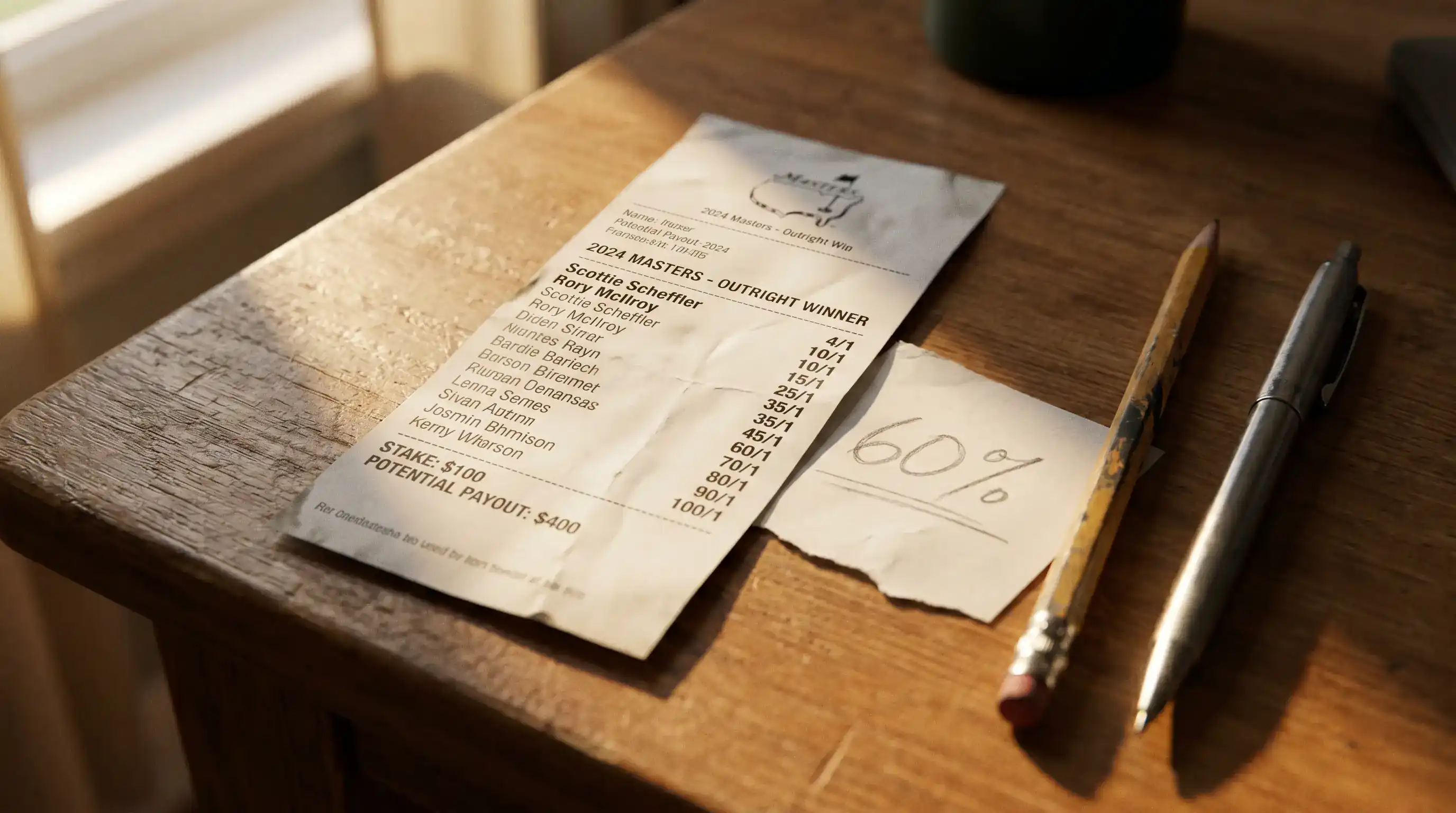
The partial-cash-out figure I use most often is 60 per cent. Lock 60 per cent of the ticket, leave 40 per cent open. The locked portion covers the realistic downside risk if the lead collapses; the open portion preserves enough upside that a successful close on Sunday still produces a meaningful headline payout. The exact split depends on the position size relative to bankroll — bigger positions should lock more, smaller positions can leave more open without breaching variance discipline.
How Cash-Out Behaves on Each-Way Tickets
Each-way cash-out is two cash-outs in one product, priced separately by the operator. The win leg and the place leg carry different residual probabilities and different fair values; the operator’s combined offer is the sum of the two leg-level offers minus the combined margin.
The interesting wrinkle. The place leg often settles cleanly before the win leg does. A player in T2 with one hole to play has effectively secured the place leg — the bookmaker knows it, the place leg’s residual fair value is near-certain, and the partial cash-out price on the place leg can sit very close to the full place dividend. The win leg, by contrast, is still uncertain — needs a playoff or an unlikely birdie-versus-bogey swing on the 18th — and the win leg’s cash-out price reflects that uncertainty.

So on a £10 each-way ticket at 33/1 with your player in T2 going down the 18th, the rational cash-out behaviour is often to take the place leg cash-out at near its full dividend and let the win leg ride. Most operators don’t expose this as a separate option in the betslip interface, but the partial-cash-out percentage can be calibrated to lock approximately the place leg’s value while leaving the win leg open. Read the cash-out figure carefully — if the offered amount roughly equals your expected place return, the operator is effectively offering you the same trade.
Why the Number Feels Wrong
The psychological friction with cash-out comes from a behavioural bias that’s been studied to death in equity trading literature. Punters mentally anchor on the maximum potential return rather than on the expected value of the position. Offered £350 to settle a position with maximum return of £500, the brain treats it as a £150 loss versus the headline. The expected-value framing treats it as a comparison between £350 guaranteed and £500 × probability-of-winning.
The way to override the anchor. Pre-commit to a decision rule before the position becomes interesting. Decide on Sunday morning, before the round starts, what percentage of maximum return you’ll accept as a full cash-out and what percentage triggers a partial. Apply the rule mechanically when the offer crosses the threshold. The decision is then a calculation, not an emotion, and you’ll find your cash-out P&L stabilises across a season.

The tilt response — the urge to “recover” a cash-out you regret with a fresh in-play ticket on the same player — is the single most expensive behavioural mistake I see. Cash-out and the subsequent in-play ticket together produce a worse expected outcome than either single decision alone, because the bookmaker’s margin compounds across both tickets. Discipline beats opinion, again, on the markets that move fastest.
The Exchange Alternative
For UK punters with active Betfair Exchange accounts, the cleaner lay-off product is a direct lay on the same player or outcome. The Exchange charges a commission on winnings (typically 2 to 5 per cent depending on the membership tier) but doesn’t build a separate margin into the lay price. So a position with £400 fair value of remaining return can usually be laid off on the Exchange for £380 to £390, compared to the operator cash-out offer of £350 to £370.
The trade-off — Exchange liquidity in live golf is thinner than in football or horseracing, and the prices available for an immediate lay can be wider than the headline mid-market quote. For mid-size positions on popular outright markets, the Exchange route often delivers 5 to 10 per cent more than the operator cash-out. For thinner markets or specialist event types, the Exchange’s volume isn’t always sufficient to clear the lay at fair value, and the operator cash-out is sometimes the practical choice. The way these in-round price dynamics interact with the rest of the live betting menu — the 5-minute update window, the volatility-versus-trend distinction, the way matchup liquidity holds up under live conditions — sits in my piece on live in-play golf betting, which is the natural companion read for anyone seriously trading positions in-round.

Why is the cash-out price lower than my potential return?
The operator builds a margin into every cash-out offer. The price represents the fair value of the remaining position minus a margin of typically 5 to 10 per cent on outright golf positions. The lower offered figure compensates the operator for the pricing risk on the outcome they’re effectively buying back from you, and reflects their commercial preference for closing exposure.
Can I cash out a futures bet such as the FedExCup winner?
Yes, with most major UK operators, provided the event is still in active season and the market remains open. Cash-out pricing on long-dated futures tends to be wider than on tournament-specific markets because the residual uncertainty is greater. The combined market for season-long futures and tournament-specific in-play products is supported by an industry that handled over $2.8 billion of sports betting and iGaming revenue for Flutter Entertainment in 2024 alone.
Written by the editors at Golf bet.