
Extra Places Promotions on Golf Majors: How the Smallprint Decides the Value
 Available in US

Every Masters week my inbox fills with the same screenshot — a brightly coloured banner advertising “Paid as Ten” or “Eight Places, 1/5 the Odds”, forwarded by friends who want to know whether it’s actually a good deal. Nine times out of ten it is, marginally. The tenth time it’s a polite mugging dressed up as generosity, and unless you’ve read the smallprint you won’t know which one you’re looking at. After nine seasons of cataloguing these promotions across the four Majors, I can tell you the Wednesday banner is half the story. The eligibility clause buried under “promotional terms” is the other half — and it’s the half that decides whether the uplift is real.
What an Extra Place Actually Is
The word “extra” is doing a lot of work here. An extra-places promotion is a one-off, event-specific extension of the place count in a bookmaker’s each-way market. Standard terms on a regular PGA Tour stop pay five places at 1/4 of the win odds. The Majors normally extend that to eight or ten at 1/5. The “extra places” promo pushes that further — eight becomes ten, ten becomes twelve, occasionally fourteen.
What it isn’t — it’s not a separate market. It’s not a new bet type. It’s the standard each-way ticket with the place count temporarily lifted for one tournament. Your win leg is unchanged. The fraction is usually unchanged. The maths is identical to a normal each-way settlement. The only thing that’s different is how far down the leaderboard your player can finish and still trigger a place return.
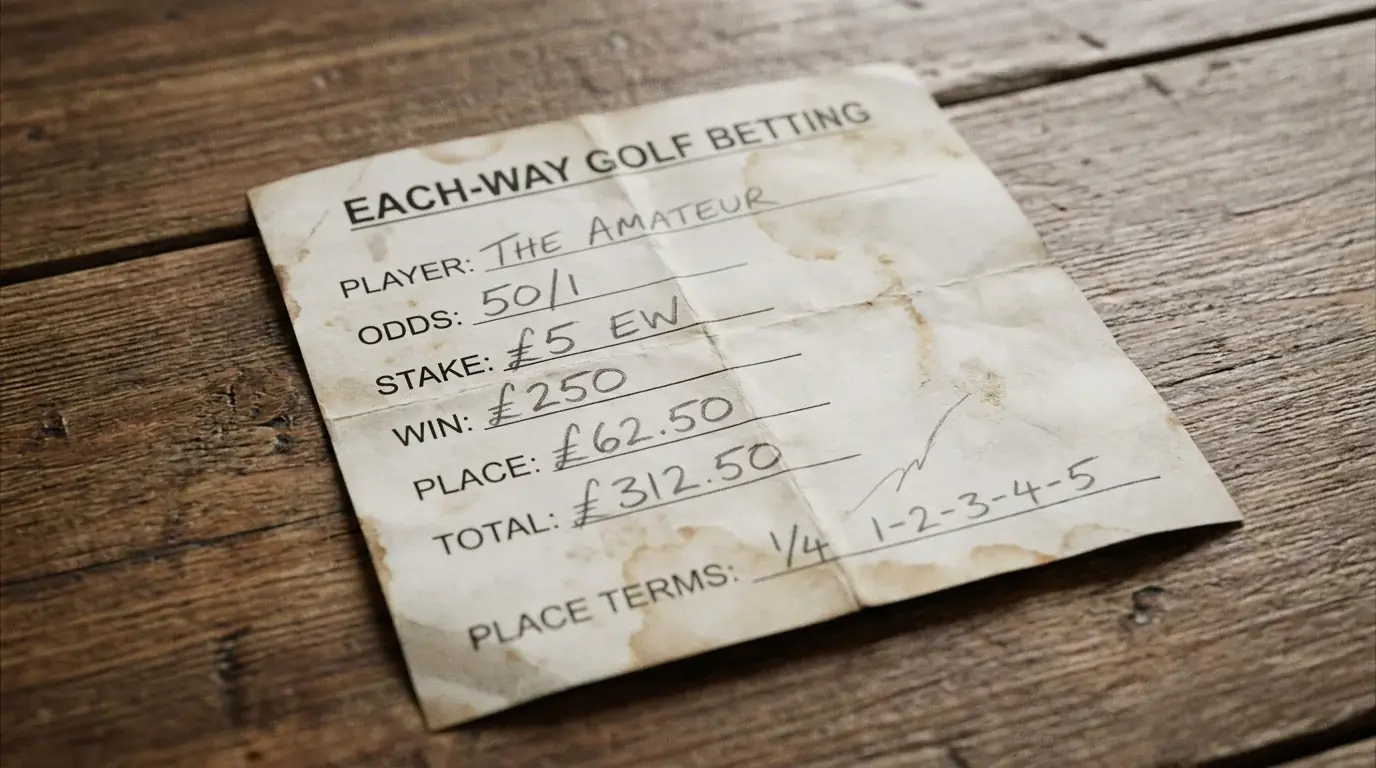
Because the underlying mechanic is so familiar, most punters skim the T&Cs and assume the promo is a strict improvement. It usually is. But “usually” hides the cases where a £25 stake cap, a market-by-market exclusion, or an awkward fraction interaction quietly removes the value the headline implies.
What the Four Majors Typically Pay
The four Majors don’t behave identically as promotional events. Each one has a settled rhythm that shapes what the UK market offers.
The Masters runs the tightest field of the four. Roughly 89 invitees, no Monday qualifier, no qualifier series. With a smaller field the standard each-way terms across UK books tend to be eight places at 1/5, with extra-places promos most commonly extending to ten. The Masters is the Major where extra places land most reliably — a smaller field means the tenth-placed finisher tends to be three or four shots clear of the eleventh, so dead-heat dilution at the cut-off line is rarer than at the other three Majors.

The Open Championship is the opposite case. The field is 156 players, with about 65 per cent arriving through 28 separate exemption categories and another 46 places coming through the Open Qualifying Series. That structure produces deeper leaderboards and tighter clusters at every place. UK operators typically offer ten places at 1/5 as standard for The Open, with extra-places promos extending to twelve. The headline uplift looks more generous than at The Masters. The settlement reality, factoring in dead-heat exposure on a deep field, often delivers less marginal value than the banner suggests.
The US Open and US PGA Championship sit between those two poles. Both run 156-player fields, both typically offer eight places at 1/5 as a Majors-standard baseline, both occasionally bump to ten under promo. The US Open is the Major where the leaderboard most reliably stretches due to penal setup — top-ten is harder to reach, dead-heat at the cut-off less likely. The US PGA, with its rotating venues, behaves differently year to year and is the Major where the gap between standard and promo terms most often produces a meaningful edge.
The Real Expected Value Maths
Let’s run an honest worked example. £10 each-way at 40/1, fraction 1/5, two scenarios — standard five places paid versus a promo extending to eight places paid. Same player, same tournament, same fraction.
Scenario A, five places. The win leg pays £400 plus £10 stake return — £410 — if your player wins. The place leg pays £5 × (40/5 + 1) = £45 if your player finishes in the top five. Combined ticket return on a win is £455, on a top-five finish is £45 plus the £5 lost win stake, so £40 profit on a £10 outlay.

Scenario B, eight places. Same win leg numbers. The place leg still pays £45 on a top-five, but now also pays £45 on a top-eight finish where your player would have walked away with nothing under standard terms. The marginal value is whatever the probability difference is between “finishes top-five” and “finishes top-eight” multiplied by £45 — and that probability difference for a 40/1 outsider in a Major field is typically in the 4 to 6 per cent range based on the recency-weighted simulation models I run for course-fit pricing.
So the realistic expected-value uplift on the promo, before dead-heat dilution, is somewhere around 18 to 27 pence per pound staked. After dead-heat dilution at the deep places of a 156-player Major, the realised number tends to settle closer to 14 to 20 pence. Both are positive. Both are smaller than the banner implies. Dead heat is the single biggest reason why headline uplift and realised uplift diverge, and I’ve walked through the full mechanic in my piece on stake reduction at tied positions for anyone who wants to see the formula step by step.
How the Promo Interacts With Tied Positions
Quick principle, no maths in this section because the maths sits in the linked article. The deeper down the leaderboard the bookmaker is paying, the more often the cut-off slot ends up shared among three or four players. The eighth place at The Open is statistically far more likely to be a four-way tie than the fourth place at the same event. That’s a structural feature of golf scoring, not a bookmaker trick.
The consequence — the marginal place that the promo adds is also the place most likely to deliver a reduced-stake settlement. Your headline £45 place return on the eighth position will, on a meaningful percentage of weeks, land as £15 or £11.25 because three or four players shared the slot. This isn’t a reason to ignore extra-places promos. It’s a reason not to assume the uplift is the full headline number. Realised EV is what matters, and realised EV factors dilution in.

The Eligibility Smallprint
The clauses I read first, in order, every time a promo lands in the diary.
Maximum stake. Almost every UK extra-places promo carries a stake cap, usually somewhere between £10 and £25 on the each-way bet. Stake above the cap reverts to standard terms. If you’re a £50-a-pop punter, the promo on a £25 cap is a quarter-stake at promo terms plus a three-quarter-stake at standard. Read the cap before you size the ticket.

Market exclusions. The promo usually applies to the outright winner each-way market. It usually does not apply to top-finish markets, group winner, first-round leader, or bet-builder legs. If you’ve been thinking about an each-way ticket on a top-twenty market under a promo banner that says “Eight Places Paid”, check whether the banner refers to outrights only.
Time window. Promos at Majors usually open Monday morning and close on tee time Thursday. Bets placed after the first ball is struck revert to standard terms. This catches more punters than it should — a £30 stake placed thirty seconds late settles at the original five places paid rather than the promo eight.
Account-type restriction. Some promos are new-customer-only. Others apply to all customers but exclude certain payment methods or accounts flagged for promo abuse. If you’re not seeing the promo terms reflected in the betslip price preview, the eligibility clause is usually the answer.
A Five-Field Promo Comparison Sheet
This is the mental checklist I run when two bookmakers are advertising competing promos on the same Major, and the choice isn’t obvious from the banner.
Field one — number of paid places under promo. Eight versus ten changes the realised uplift by roughly fifty per cent at a deep-field Major.

Field two — fraction. 1/4 with eight places paid often delivers more than 1/5 with ten places, depending on the win odds of your selection. Run the place dividend for both and pick the higher number after dead-heat dilution.
Field three — maximum stake. A £10 cap on a generous promo is functionally less valuable than a £50 cap on a moderate promo if you stake serious money.
Field four — exclusions. Does the promo apply to the markets you actually bet? If you only ever play top-twenty, an outright-only promo is irrelevant to your slate.
Field five — boost-cap interaction. If the operator also runs an odds-boost promo and the two are mutually exclusive, the lower-value promo just becomes overhead. Read the combination clause before you commit.
Run the five fields, score each on a five-point scale, total them, and pick the winner. It takes about ninety seconds per promo and saves more in mis-priced tickets than it costs in time across a Majors season. The UK gambling market generated total gross gambling yield of £15.6 billion in 2025; the marginal value extracted from promotions is meaningful precisely because it’s the part of that yield the operator chooses to give back. Read the smallprint and you keep more of it.
Do extra places apply to in-play bets?
Almost never. UK extra-places promos at Majors typically apply only to pre-tournament each-way wagers placed before the first tee shot on Thursday morning. Once the market goes live, the terms revert to the standard place count and any in-play stake settles under the baseline each-way terms.
Can I combine extra places with an odds boost on the same ticket?
Rarely. Most UK operators specify in the promo T&Cs that extra-places promotions cannot be combined with other concurrent offers on the same selection. Read the combination clause carefully — the headline might survive on one promo but vanish the moment a second is applied.
Created by the ”Golf bet” editorial team.