
Ante-Post Golf Betting: Locking In Long Before Tee Time
 Available in US

The first ante-post bet I won big on was an Open Championship futures slip placed in February for a 100/1 outsider. By the time the Open arrived in July, the same player was 33/1 and the ticket I held was the best price I’d seen on him in five years. Ante-post betting on golf has paid me more proportionally than any other betting style, but it’s also lost me more outright stakes than any other style — because the risk of withdrawal is real and the rules around it bite hard. This piece is the framework I use for ante-post golf and the questions UK punters should ask before placing one.
Table of Contents
- What an ante-post bet is and how it differs
- The withdrawal risk that defines ante-post
- When ante-post pricing offers genuine value
- When to take the price and when to wait
- Seasonal futures and the long-haul markets
- Each-way ante-post and the place pool
- Bookmaker-specific terms to check
- Why ante-post stays in my routine
What an ante-post bet is and how it differs
A reader asked me last winter what the line was between an ante-post bet and an ordinary outright bet. The technical line is timing: ante-post is any bet placed before the final field is confirmed for an event. In practice, that means roughly anything more than a week before tee-off at most UK firms.
The structural difference between ante-post and standard outright betting is in the withdrawal risk. A standard outright bet placed in tournament week typically refunds the stake if the player withdraws before the first tee shot. An ante-post bet generally does not — once the bet is placed, the punter is committed regardless of whether the player actually competes. That asymmetry is the whole reason ante-post prices are longer than tournament-week prices on the same player.

The compensation for the withdrawal risk is price. Ante-post prices on Major contenders are routinely 30 to 100 percent longer than the same player’s tournament-week prices, depending on how far ahead the bet is placed and how much the player’s form has shifted. The 100/1 Open winner I backed in February would have been 50/1 by May and 33/1 in tournament week — the early price reflected genuine uncertainty about whether he’d qualify and whether his form would hold.
The withdrawal risk that defines ante-post
I lost an ante-post bet on the 2014 US Open when my player withdrew with a wrist injury two weeks before the championship. The stake was gone, no refund, no recourse. That loss taught me to think about withdrawal risk as a separate dimension from price value — a 100/1 ante-post price isn’t a 100/1 effective price if the player’s withdrawal probability is significant.
Withdrawal risk varies massively across players. A 35-year-old veteran with a history of back problems carries higher risk than a 25-year-old who has played every tournament for three years. A player with a recent surgery announcement carries higher risk than a player coming off a top-10 finish. The price boards don’t usually reflect those differences — the same ante-post price might be applied to high-risk and low-risk players alike, which creates structural opportunities for punters who pay attention.

UK firms have different policies on ante-post withdrawal refunds. Some firms offer “non-runner no bet” terms on ante-post markets for certain qualifying events; others apply standard ante-post rules with no refunds. Reading the terms before placing is essential, and the terms can differ by event within the same firm — Major championships often get more punter-friendly terms than regular tour events.
When ante-post pricing offers genuine value
The best ante-post value typically appears in three scenarios. First, several months before an event when the field is uncertain and the price reflects that uncertainty. Second, immediately after a player’s poor performance has temporarily lengthened his price beyond his true probability. Third, before a player’s qualifying path is secured — when the bookmaker has priced in qualification doubt that may resolve favourably.
The 2025 Open Championship was the cleanest recent example of ante-post pricing premium. Scottie Scheffler went off at +500 as the shortest Open favourite in over a decade, but the ante-post pricing six months earlier had him at 12/1. The Ryder Cup outright was 70 percent USA action by handle at BetMGM, with 58 percent of tickets and 68 percent of money on the USA — a heavy market lean that the ante-post pricing the previous winter had only partially anticipated. Both events demonstrate how much can move between ante-post pricing and tournament-week pricing.
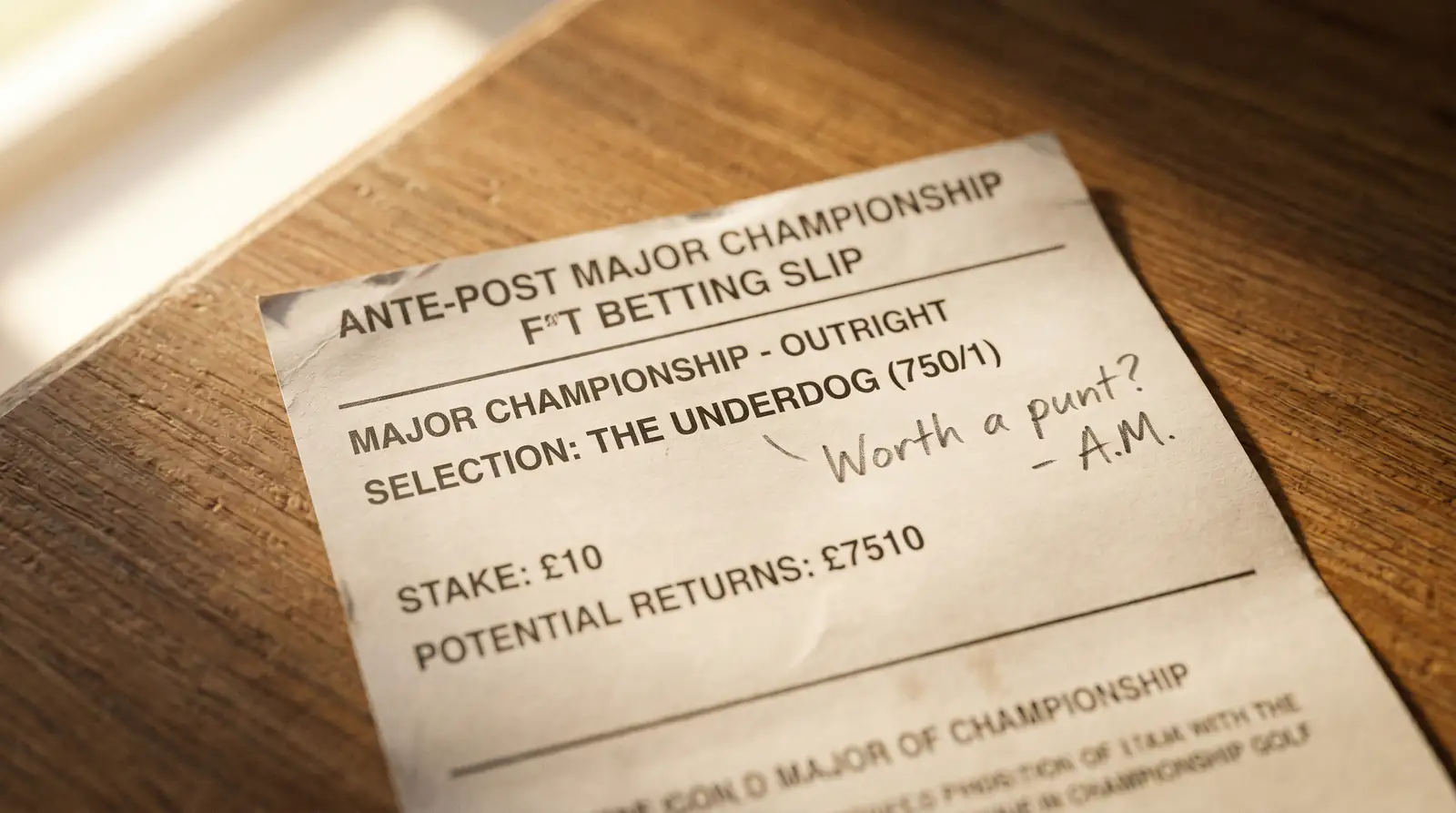
The trick is identifying which ante-post prices reflect genuine value versus which reflect risk you’re not seeing. A 100/1 ante-post price could be a market mispricing or could be the bookmaker correctly pricing a player with material withdrawal risk. Doing the homework on injury history, schedule plans and qualifying path is how you separate the two.
When to take the price and when to wait
The decision to bet ante-post versus to wait for tournament week is a price-versus-risk trade-off. The price advantage of ante-post needs to compensate for the withdrawal risk, the form-shift risk, and the opportunity cost of capital tied up for months. The broader question of sizing those positions sits inside my piece on bankroll management for UK golf punters, which addresses the unit sizing maths that ante-post betting demands.
The clearest case for taking the ante-post price is when the punter has high confidence in the player’s continued participation and the price advantage is at least 50 percent over expected tournament-week prices. A 100/1 ante-post on a player who looks like he’ll be 50/1 in tournament week, with low withdrawal risk, is a strong proposition. A 33/1 ante-post on a player likely to be 25/1 in tournament week is marginal — the price advantage doesn’t justify the risk.

The case for waiting is when the player has known injury concerns, ambiguous schedule plans, or qualifying path uncertainty that won’t resolve until close to the event. Better to take the worse price with the certainty of participation than the better price with the uncertainty of refund.
Seasonal futures and the long-haul markets
Season-long futures markets — Race to Dubai winner, FedExCup winner, top scorer for the year — are ante-post by their nature. The bets are placed in January and don’t settle until November or December. The pricing on these markets is generally less efficient than tournament-specific ante-post pricing because the trading desks have to make assumptions about an entire season’s worth of competitive structure.
UK firms post seasonal futures on the Race to Dubai, the FedExCup, individual player season win totals, and top finisher in various year-long rankings. The prices move slowly through the year as form develops, but they don’t always move efficiently. A player who has won twice by April and is leading the Race to Dubai might still be 6/1 in late spring when his fair price is 7/2.

The seasonal futures I like most are the player-specific markets — over/under win totals, top continent player for the season, season-long top-10 finish counts. These markets are thinner than the headline outright but the trading is also less aggressive, and prices that drift away from realistic projections can stay drifted for weeks before correcting.
Each-way ante-post and the place pool
Each-way on ante-post markets generally follows the same place terms as the tournament-week market — eight places at 1/5 for most Majors, six or seven places at 1/5 for regular events. The maths is identical: stake half on the win, half on the place at the place fraction.
The wrinkle is that ante-post each-way carries the same withdrawal risk as ante-post outright. If the player doesn’t tee off, the entire stake (both halves) is lost in most cases. That’s important because each-way bets are often placed at longer prices than win-only bets, which means the absolute stake on each-way can be larger — and the absolute loss on a withdrawal is correspondingly larger.

The place portion of an each-way ante-post on a longshot is often where the genuine value sits. A 200/1 ante-post each-way at 1/5 eight places pays 40/1 on the place side, against an implied probability of landing top-eight that’s significantly higher than the win probability. For longshots with secure qualifying paths and low withdrawal risk, each-way ante-post is one of the more reliably profitable styles I run.
Bookmaker-specific terms to check
The specifics of ante-post rules vary by bookmaker and are not always front-and-centre. Some UK firms offer non-runner no bet on Major championships once the field is confirmed but standard ante-post terms before that confirmation. Some firms offer non-runner no bet on all ante-post bets but at slightly shorter prices. Some firms apply standard ante-post rules across the board with no refund options.
The other terms worth checking are the deadline definitions. When does ante-post end and standard outright begin at each firm? Usually it’s when the final field is confirmed, but the exact timing differs. Some firms switch to standard rules on the Friday before the event; others wait until tee-off. The difference can matter if a player’s status changes during that window.

Each-way fractions and place counts can also differ between ante-post and tournament-week markets at the same firm. The ante-post place terms are sometimes more conservative than the tournament-week terms. Reading the specifics before placing is essential — the headline win price tells you only half the story.
Why ante-post stays in my routine
Ante-post betting is the highest-variance product on the UK golf calendar. The wins are larger than tournament-week wins on the same player; the losses include withdrawal-driven dead money that tournament-week betting avoids. The discipline is in committing only the stake you can afford to leave dead, doing the injury and schedule homework before placing, and keeping ante-post positions a modest fraction of total betting volume rather than the centrepiece. Done that way, ante-post is one of the more reliably profitable styles for patient punters. Done sloppily, it’s a slow drain. The mathematics rewards the patient version.
Ante-post bets generally do not refund if the player withdraws before the event. The stake is committed at the moment of placing the bet, and a withdrawal due to injury, illness, personal reasons or any other cause typically results in the stake being lost. Some UK firms offer non-runner no bet terms on certain qualifying ante-post markets — usually Major championships once the field is officially confirmed — but those terms are the exception rather than the rule. Some UK firms allow cash-out on ante-post bets if the player’s price has moved favourably and the firm’s cash-out engine extends to the relevant market. The cash-out value will be lower than the theoretical fair price because the firm prices in the remaining time risk and the withdrawal risk. Cash-out is more commonly available on Major championship ante-posts and on shorter-priced contenders than on longshot or non-Major ante-posts.What happens to my ante-post bet if a player gets injured?
Can I cash out an ante-post bet before the event?
Published by the Golf bet team.